
The conventional view is that, if parallel universes exist, they are separate from one another.
This conclusion is understandable, but it rests on an important assumption: that separate universes never touch.
There is no particular reason to assume this.
If the multiverse consists of countless universes existing alongside one another, it is reasonable to suppose that their boundaries may occasionally approach, overlap, or become unusually thin.
A Vortex is what happens when they do.
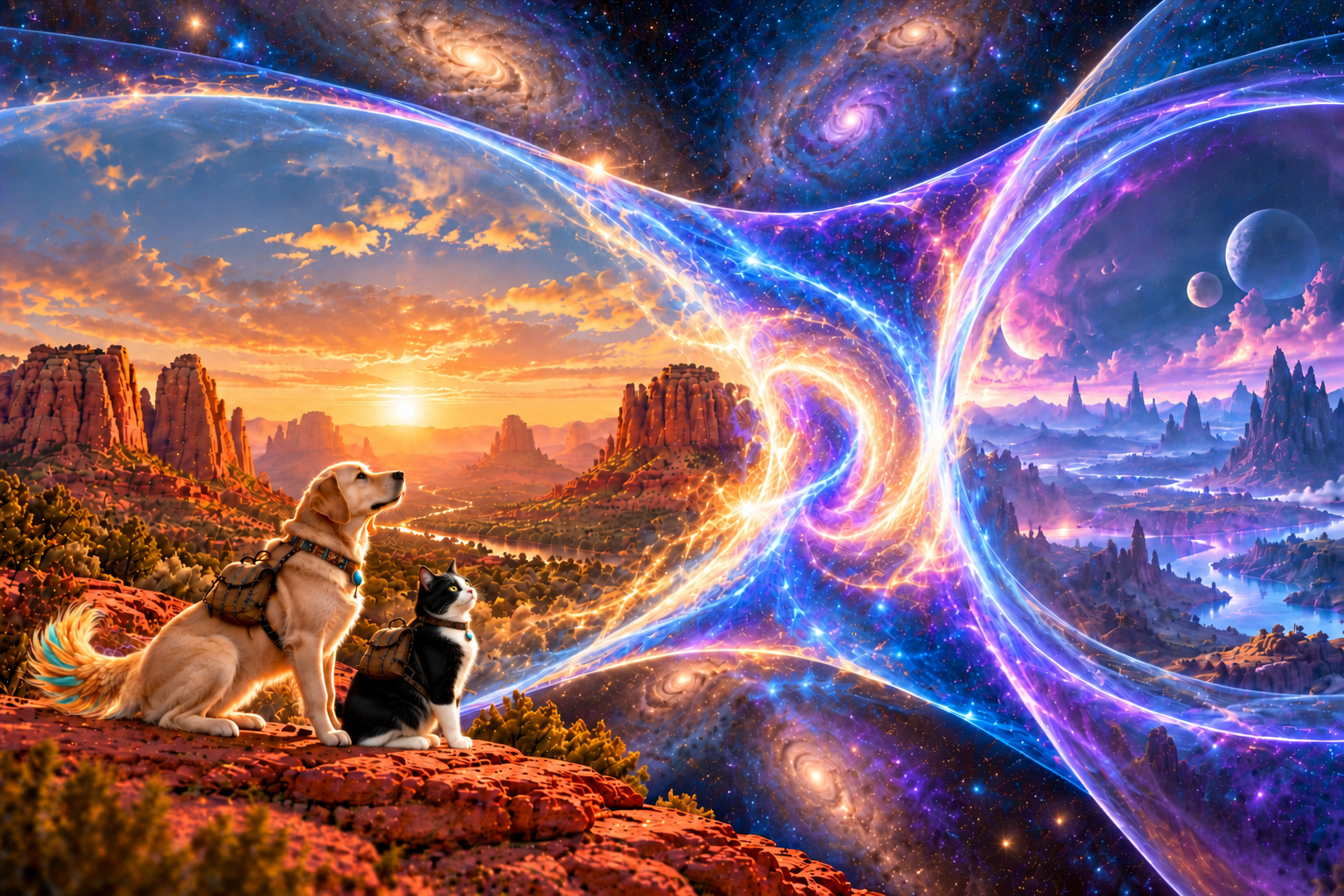
At certain locations, the distance between two parallel universes becomes sufficiently small that matter can pass from one to the other. These locations are not holes in space in the ordinary sense. They are places where the distinction between here and somewhere else becomes temporarily negotiable.
Sedona possess an exceptional number of such locations.

Exactly what exists in the space between universes remains uncertain. The Overlapping Quantum State Theory suggests that it is not entirely empty. Every living thing passing through a Vortex may leave behind an infinitesimal portion of itself while carrying something of that space away.
After millions of years and countless crossings, this exchange may have produced something unexpected.
The Vortex may no longer be merely a passage between universes.
It may have become a participant.